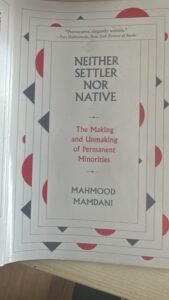
Neither Settler Nor Native: The Making and Unmaking of Permanent Minorities
Book review – Mahmoud Issa
NB (The Arabic version of the comment will follow the English)
ملاحظة: الترجمة العربية للتعليق تأتي بعد النص الإنجليزي.
لا مستوطن ولا أصلي: نشأة الأقليات الدائمة وتفكيكها
مراجعة كتاب – محمود عيسى
1. Introduction
Anyone seeking to understand how the ethnic cleansing of Palestine unfolded in 1948, how approximately two-thirds of the Palestinian Arab population were uprooted from their homes, and how this historical dispossession has continued over subsequent decades, culminating in the genocide in Gaza since 2023, should read this book.
It offers an illuminating account of the complicit role played by Western European powers, particularly Britain, and, in more recent decades, the United States, in enabling and sustaining colonial policies.
Mahmood Mamdani provides a powerful historical and theoretical framework for understanding how the colonial paradigms and mechanisms of dispossession that devastated the Indigenous populations of the Americas were subsequently applied, in different forms, to the Indigenous peoples of Palestine, Aboriginal Australians and the Māori of New Zealand.
The author argues that the political and legal structures underpinning these historical processes are not isolated phenomena. Rather, they are deeply rooted in the formation of the modern nation-state and its colonial foundations.
One cannot help wondering whether Zohran Mamdani, the author’s son, has also been influenced by his father’s political and intellectual ideas. His challenge to established oligarchic and financial interests in New York, his emphasis on the needs of ordinary people rather than concentrated wealth, and his rejection of political divisions based on religious and ethnic identities appear to resonate with some of the central arguments developed in this book.
At the heart of Mamdani’s argument is the need to overcome political structures that perpetuate divisions between majorities and minorities, and to build a political community in which people are equal citizens rather than permanent representatives of competing religious or ethnic identities.
2. 1492: The origins of the modern nation-state
Rather than beginning his historical investigation with the signing of the Treaty of Westphalia in 1648, conventionally associated with the emergence of the modern state system, Mamdani takes us further back, to 1492.
That was the year Granada fell to the Catholic monarchs, bringing Muslim political rule in the Iberian Peninsula to an end, and the year Christopher Columbus reached the Americas. For Mamdani, these two events mark a decisive turning point in the formation of the modern nation-state and the emergence of European overseas colonialism.
As he explains in his introduction, the regime of tolerance associated with the Westphalian settlement came later. It did not eliminate the distinction between political majorities and minorities; rather, it institutionalised it.
Mamdani identifies two interconnected dimensions of the policies pursued by the Castilian monarchy: internal ethnic and religious homogenisation and external colonial expansion.
Internally, Jews and Muslims were subjected to persecution, forced conversion, expulsion and other forms of exclusion. Externally, European powers embarked on the conquest, colonisation and domination of overseas territories, particularly in the Americas.
In this sense, modern colonialism and the modern nation-state were not separate historical developments. They emerged together and shaped one another.
Mamdani challenges the conventional assumption that nationalism preceded colonialism, or that colonialism represented simply the final stage in the development of the nation-state. As he writes:
“Nationalism did not precede colonialism. Nor was colonialism the highest or the final stage in the making of a nation. The two were co-constituted.”
This is one of the book’s most important arguments.
In Mamdani’s interpretation, the modern nation-state is therefore less an engine of tolerance than an instrument of conquest and political exclusion.
After 1648, minorities could be tolerated within the boundaries of the emerging European nation-states, provided they demonstrated political loyalty to the dominant national community. Tolerance, however, did not necessarily mean equality. It often meant accepting a subordinate position within a political order structured around a dominant majority.
The situation in overseas colonies was fundamentally different. Indigenous populations were not incorporated as equal members of the emerging European nation-states.
There, conquest, dispossession, forced displacement, racial classification, terror and genocide became instruments of colonial rule.
The Indigenous inhabitants of the Americas were classified as a separate population, referred to by Columbus as Indians, and subjected to a political and legal order that denied them equal standing in the societies established on their ancestral lands.
Mamdani’s analysis makes the connection with Palestine particularly compelling. The insistence on defining Israel as a Jewish state, rather than as a state belonging equally to all its citizens, illustrates the persistence of the colonial political logic he examines. He develops this argument in considerable detail, particularly on pages 251–317.
3. The dispossession of Indigenous peoples in the Americas
One of the most fascinating aspects of the book is its historical examination of the past four to five centuries, from the European conquest of the Americas to the contemporary political order.
Mamdani demonstrates how the paradigms of conquest, domination and colonisation were repeatedly adapted to different historical circumstances.
The Indigenous peoples of the Americas were deprived of their ancestral lands, forced into agreements that undermined their rights, and subjected to systematic discrimination. Even after the American Revolution, the new republic continued many of the colonial practices that had characterised European expansion.
An especially revealing example appears on page 54. The Treaty of Hopewell, signed with the Cherokee in November 1785, included a provision recognising the right of Indigenous peoples to send a representative of their choice to Congress.
Subsequent political proposals even envisaged the establishment of a permanent Indigenous homeland in Indian Territory, with its own government.
Yet these proposals existed alongside a much more coercive colonial reality.
The Indian Removal Act of 1830 formalised the policy of removing Indigenous peoples from their ancestral territories. What followed included forced displacement, dispossession and devastating violence, forming part of a much longer history of genocidal destruction.
Mamdani also discusses the catastrophic demographic consequences of European conquest. He cites estimates suggesting that the Indigenous population of the Americas declined from approximately 100 million to 10 million between 1492 and the founding of the United States.
Although the precise figures remain debated among historians, the scale of the demographic catastrophe is undeniable.
The book also draws on the distinction associated with Friedrich Engels between different forms of European colonial expansion in North and South America: settler colonisation in the North and other forms of domination and exploitation in the South.
This distinction helps illuminate the different ways in which colonial power was exercised across the continent.
4. Palestine: A continuation of the colonial paradigm
The Palestinian case is among the most significant contemporary examples through which Mamdani’s theoretical framework can be understood.
The dispossession of Palestinians in 1948, the destruction of hundreds of Palestinian villages, the establishment and expansion of Israeli settlements, and the continued denial of the right of return to Palestinian refugees all raise fundamental questions about the relationship between colonialism, national identity and statehood.
Israel’s insistence on maintaining the state’s exclusively Jewish national character, particularly when considered alongside the political and legal status of Palestinian citizens of Israel, illustrates the contradiction between a state defined around one national group and the principle of equal citizenship.
Mamdani’s analysis is particularly relevant because he challenges the assumption that permanent political divisions between majority and minority populations can provide a sustainable foundation for a democratic political community.
The Palestinian question is therefore not simply a territorial dispute. It is also a fundamental question about the nature of the state, the meaning of citizenship, and the rights of the people who were expelled and those who continue to inhabit the land.
Mamdani extends his analysis beyond Palestine, examining South Africa, Sudan and other historical and contemporary examples to demonstrate how colonial political structures continue to shape conflicts long after formal colonial rule has ended.
5. From the colonial state to a state of equal citizens
Published in 2020, the book could not have anticipated the subsequent political developments in Israel, particularly the genocide in Gaza since 2023 and the dramatic political developments reflected in the Israeli elections of October 2026. Nevertheless, these developments provide a striking contemporary illustration of some of the questions Mamdani raises.
In the Israeli parliamentary elections of 27 October 2026, the two Arab-led political blocs won a combined 19 seats in the 120-member Knesset. This represented a significant increase in their parliamentary presence and gave Arab political representation considerable importance in the negotiations over the formation of the next government. The results also prompted renewed political debate about the legitimacy and influence of Arab participation in Israeli politics.
The controversy exposes a fundamental contradiction: Palestinian citizens of Israel have the right to vote and participate in parliamentary elections, yet their political influence may still be challenged when it threatens the established political balance. This is precisely the kind of contradiction that makes Mamdani’s analysis relevant today.
The continuing colonisation of the West Bank, the destruction and devastation of Gaza, the forced displacement of Palestinians from refugee camps in the West Bank, particularly Jenin, Tulkarm and Nur Shams, and attempts to delegitimise the political participation of Palestinians inside Israel all demonstrate the urgent need to rethink the political foundations of the state.
There is a possible alternative, however difficult it may appear: to delink the nation from the state and establish a political community based primarily on equal citizenship.
This would require revoking the discriminatory principles embodied in Israel’s 2018 Basic Law: Israel as the Nation-State of the Jewish People, particularly its provision that the right to exercise national self-determination in the State of Israel is exclusive to the Jewish people.
As Mamdani writes on page 251:
“Israel as a Jewish state means that it is neither democratic nor secular nor protective of equal rights of its inhabitants.”
He further argues:
“Non-Jewish citizens in Israel are second-class citizens in law, officially denied state services and marked for dispossession.”
Mamdani also quotes Tzipi Livni:
“I would like to see the state of Israel be the home for Arab Israelis, but it cannot be their national home.”
These statements raise a fundamental question about whether a state defined by the national identity of one people can guarantee genuine political equality to all its citizens.
The alternative could be a single democratic state for all its citizens, irrespective of religion, faith, ethnicity, race or gender, founded on equal political, civil and human rights.
Such an approach would open the way to a radically different political vision, particularly after decades of unsuccessful attempts to implement what is known as the two-state solution.
The history of partition in Cyprus, India and Sudan also raises questions about the ability of territorial division along ethnic or national lines to deliver lasting peace. These experiences are not identical, and each has its own historical circumstances. Nevertheless, they demonstrate that dividing territory does not, in itself, resolve the underlying problems of identity, citizenship and political equality.
South Africa, by contrast, offers an important example of a transition from an institutionalised system of racial segregation to a political order based on universal suffrage and equal citizenship. Its experience demonstrates the possibility of building a common political framework in which different communities participate as equal citizens.
Mamdani also explores the possibility of a binational state, moving beyond the assumption that political sovereignty must belong exclusively to one national community.
Such a political solution must also address the right of return of Palestinian refugees uprooted in 1948, who, together with their descendants, constitute approximately half of the Palestinian people, now numbering around 15 million worldwide.
The denial of the refugees’ right of return and compensation, as addressed in UN General Assembly Resolution 194, remains central to correcting the historical injustices endured by Palestinians for nearly eight decades. Their continued exclusion from their lands, villages and towns, and the loss of their heritage, identity and cultural roots, cannot be separated from the question of a just political settlement.
Ultimately, the question is not simply how to divide the land between competing national identities. It is how to establish a political order in which everyone enjoys equal rights, irrespective of faith, colour, gender or sexual orientation.
That is the fundamental challenge raised by Mamdani’s book.
مراجعة كتاب
لا مستوطن ولا أصلي: نشأة الأقليات الدائمة وتفكيكها
مراجعة كتاب – محمود عيسى
1. مقدمة
على كل من يرغب في فهم الكيفية التي جرى بها التطهير العرقي لفلسطين عام 1948، وكيف اقتُلع نحو ثلثي السكان العرب الفلسطينيين من بيوتهم وأرضهم، وكيف استمر هذا الاقتلاع التاريخي خلال العقود اللاحقة، وصولاً إلى الإبادة الجماعية المستمرة في غزة منذ عام 2023، أن يقرأ هذا الكتاب.
كما يقدم الكتاب عرضاً كاشفاً للدور المتواطئ الذي لعبته القوى الأوروبية الغربية، ولا سيما بريطانيا، والولايات المتحدة في العقود الأخيرة، في تمكين السياسات الاستعمارية وترسيخها واستمرارها.
يقدم محمود ممداني إطاراً تاريخياً ونظرياً بالغ الأهمية لفهم الكيفية التي أُعيد بها تطبيق الأنماط الاستعمارية وآليات الاستيلاء على الأراضي، التي دمرت السكان الأصليين في الأمريكتين، بأشكال مختلفة، على السكان الأصليين في فلسطين، والسكان الأصليين في أستراليا، وشعب الماوري في نيوزيلندا.
ويرى المؤلف أن البنى السياسية والقانونية التي تقوم عليها هذه العمليات التاريخية ليست ظواهر منفصلة أو معزولة، بل هي متجذرة في صميم نشأة الدولة القومية الحديثة وأسسها الاستعمارية.
ولا يسع المرء إلا أن يتساءل عما إذا كان زهران ممداني، نجل المؤلف، قد تأثر هو الآخر بالأفكار السياسية والفكرية لوالده. فمواجهته للمصالح المالية والاحتكارية الراسخة في نيويورك، وتركيزه على مصالح الناس العاديين بدلاً من الثروات المتركزة في أيدي قلة، ورفضه للانقسامات السياسية القائمة على الهويات الدينية والإثنية، تبدو جميعها متقاطعة مع بعض الأفكار المحورية التي يطرحها هذا الكتاب.
وفي صميم أطروحة ممداني تكمن ضرورة تجاوز البنى السياسية التي تكرّس الانقسام بين الأغلبيات والأقليات، والعمل على بناء مجتمع سياسي يكون فيه الناس مواطنين متساوين، لا ممثلين دائمين لهويات دينية أو إثنية متنافسة.
2. عام 1492: جذور الدولة القومية الحديثة
بدلاً من أن يبدأ ممداني بحثه التاريخي بتوقيع معاهدة وستفاليا عام 1648، التي يُربط بها تقليدياً ظهور نظام الدولة الحديثة، فإنه يعود بنا إلى الوراء، إلى عام 1492.
ففي ذلك العام سقطت غرناطة في أيدي الملوك الكاثوليك، وانتهى الحكم السياسي الإسلامي في شبه الجزيرة الإيبيرية، وهو العام نفسه الذي وصل فيه كريستوفر كولومبوس إلى الأمريكتين. ويرى ممداني أن هذين الحدثين شكّلا نقطة تحول حاسمة في نشأة الدولة القومية الحديثة وبداية الاستعمار الأوروبي وراء البحار.
وكما يوضح في مقدمته، فإن نظام التسامح المرتبط بتسوية وستفاليا جاء في مرحلة لاحقة. لكنه لم يلغِ التمييز بين الأغلبيات والأقليات السياسية، بل عمل على إضفاء طابع مؤسسي عليه وترسيخه.
يحدد ممداني بُعدين مترابطين للسياسات التي اتبعتها الملكية القشتالية: التجانس الإثني والديني داخل البلاد، والتوسع الاستعماري خارجها.
ففي الداخل، تعرض اليهود والمسلمون للاضطهاد والتحويل القسري إلى المسيحية والطرد، فضلاً عن أشكال أخرى من الإقصاء. أما في الخارج، فقد انطلقت القوى الأوروبية في مشاريع الغزو والاستعمار والسيطرة على الأراضي الواقعة وراء البحار، ولا سيما في الأمريكتين.
وبهذا المعنى، لم يكن الاستعمار الحديث والدولة القومية الحديثة تطورين تاريخيين منفصلين، بل نشآ معاً وأثر كل منهما في الآخر.
يتحدى ممداني الافتراض التقليدي القائل إن القومية سبقت الاستعمار، أو إن الاستعمار كان مجرد المرحلة الأخيرة في تطور الدولة القومية. ويكتب:
«لم تسبق القوميةُ الاستعمارَ، كما لم يكن الاستعمار أعلى مراحل تشكّل الأمة أو مرحلتها الأخيرة. لقد تشكّل الاثنان معاً، وأنتج كل منهما الآخر».
وهذه واحدة من أهم الأفكار التي يطرحها الكتاب.
فالدولة القومية الحديثة، وفقاً لتفسير ممداني، لم تكن بالضرورة محركاً للتسامح، بقدر ما كانت أداة للغزو والإقصاء السياسي.
وبعد عام 1648، أصبح من الممكن التسامح مع الأقليات داخل حدود الدول الأوروبية الناشئة، شريطة أن تثبت ولاءها السياسي للجماعة القومية المهيمنة. لكن التسامح لم يكن يعني بالضرورة المساواة؛ بل كان يعني في كثير من الأحيان قبول موقع أدنى داخل نظام سياسي يتمحور حول أغلبية مهيمنة.
وكان الوضع مختلفاً بصورة جوهرية في المستعمرات الواقعة وراء البحار، حيث لم يُدمج السكان الأصليون باعتبارهم أعضاء متساوين في الدول القومية الأوروبية الناشئة.
هناك، أصبح الغزو والاستيلاء على الأراضي والتهجير القسري والتصنيف العرقي والإرهاب والإبادة الجماعية أدوات للحكم الاستعماري.
وقد صُنّف السكان الأصليون للأمريكتين باعتبارهم جماعة منفصلة، وأطلق عليهم كولومبوس تسمية «الهنود»، وأُخضعوا لنظام سياسي وقانوني حرمهم من المساواة في المجتمعات التي أقيمت على أراضيهم التاريخية.
ويجعل تحليل ممداني الصلة بالحالة الفلسطينية واضحة بصورة خاصة. فالإصرار على تعريف إسرائيل باعتبارها دولة يهودية، بدلاً من كونها دولة ينتمي إليها جميع مواطنيها على قدم المساواة، يعكس استمرار المنطق السياسي الاستعماري الذي يتناوله المؤلف. ويطور ممداني هذه الحجة بتفصيل كبير، ولا سيما في الصفحات 251–317.
3. تجريد السكان الأصليين في الأمريكتين من أراضيهم
من أكثر الجوانب إثارة للاهتمام في الكتاب تناوله التاريخي للقرون الأربعة أو الخمسة الماضية، بدءاً من الغزو الأوروبي للأمريكتين وصولاً إلى النظام السياسي المعاصر.
يوضح ممداني كيف أُعيد توظيف أنماط الغزو والهيمنة والاستعمار، مراراً وتكراراً، بما يتناسب مع ظروف تاريخية مختلفة.
فقد جُرّد السكان الأصليون للأمريكتين من أراضيهم الموروثة عن أجدادهم، وأُجبروا على الدخول في اتفاقيات قوضت حقوقهم، وتعرضوا للتمييز المنهجي. وحتى بعد الثورة الأمريكية، واصلت الجمهورية الجديدة العديد من الممارسات الاستعمارية التي ميزت التوسع الأوروبي.
ومن الأمثلة الكاشفة التي يوردها المؤلف في الصفحة 54 معاهدة هوبويل، الموقعة مع شعب الشيروكي في تشرين الثاني/نوفمبر 1785، والتي تضمنت بنداً يعترف بحق السكان الأصليين في إرسال ممثل يختارونه بأنفسهم إلى الكونغرس.
كما طرحت لاحقاً مقترحات سياسية لإنشاء وطن دائم للسكان الأصليين في الإقليم الهندي، يتمتع بحكومته الخاصة.
لكن هذه المقترحات كانت قائمة بالتوازي مع واقع استعماري أكثر قسوة وإكراهاً.
فقد شرّع قانون ترحيل الهنود الصادر عام 1830 سياسة اقتلاع السكان الأصليين من أراضيهم التاريخية. وأعقب ذلك التهجير القسري والاستيلاء على الأراضي والعنف المدمر، في إطار تاريخ طويل من التدمير ذي الطابع الإبادي.
ويتناول ممداني أيضاً النتائج الديموغرافية الكارثية للغزو الأوروبي. وينقل تقديرات تشير إلى انخفاض عدد السكان الأصليين في الأمريكتين من نحو 100 مليون نسمة إلى 10 ملايين بين عام 1492 وتأسيس الولايات المتحدة الأمريكية.
ورغم استمرار الجدل بين المؤرخين حول الأرقام الدقيقة، فإن حجم الكارثة الديموغرافية لا يمكن إنكاره.
كما يستند الكتاب إلى التمييز الذي ارتبط بفريدريك إنجلز بين أشكال التوسع الاستعماري الأوروبي المختلفة في أمريكا الشمالية والجنوبية: الاستعمار الاستيطاني في الشمال، وأشكال أخرى من الهيمنة والاستغلال في الجنوب.
ويساعد هذا التمييز على فهم الكيفية المختلفة التي مورست بها السلطة الاستعمارية في أنحاء القارة.
4. فلسطين: استمرار للنموذج الاستعماري
تُعد الحالة الفلسطينية من أبرز الأمثلة المعاصرة التي يمكن من خلالها فهم الإطار النظري الذي يطرحه ممداني.
إن اقتلاع الفلسطينيين عام 1948، وتدمير مئات القرى الفلسطينية، وإقامة المستوطنات الإسرائيلية وتوسيعها، والاستمرار في إنكار حق العودة للاجئين الفلسطينيين، كلها تثير أسئلة جوهرية حول العلاقة بين الاستعمار والهوية القومية والدولة.
إن إصرار إسرائيل على الحفاظ على الطابع القومي اليهودي الحصري للدولة، ولا سيما عند النظر إلى الوضع السياسي والقانوني للمواطنين الفلسطينيين داخل إسرائيل، يكشف التناقض بين دولة تُعرّف نفسها حول جماعة قومية واحدة ومبدأ المواطنة المتساوية.
ويكتسب تحليل ممداني أهمية خاصة هنا، لأنه يتحدى الافتراض القائل إن الانقسامات السياسية الدائمة بين الأغلبية والأقلية يمكن أن تشكل أساساً مستداماً لمجتمع سياسي ديمقراطي.
فالقضية الفلسطينية ليست مجرد نزاع على الأرض، بل هي أيضاً قضية جوهرية تتعلق بطبيعة الدولة، ومعنى المواطنة، وحقوق الذين طُردوا من أرضهم، والذين ما زالوا يعيشون فيها.
ويوسع ممداني نطاق تحليله ليشمل جنوب أفريقيا والسودان وأمثلة تاريخية ومعاصرة أخرى، موضحاً كيف تستمر البنى السياسية الاستعمارية في تشكيل الصراعات حتى بعد انتهاء الحكم الاستعماري الرسمي.
5. من الدولة الاستعمارية إلى دولة المواطنين المتساوين
صدر الكتاب عام 2020، ولذلك لم يكن بإمكانه استشراف التطورات السياسية اللاحقة في إسرائيل، ولا سيما الإبادة الجماعية في غزة منذ عام 2023، والتطورات السياسية الكبيرة التي عكستها انتخابات تشرين الأول/أكتوبر 2026. ومع ذلك، فإن هذه التطورات تقدم أمثلة معاصرة لافتة على بعض الأسئلة التي يطرحها ممداني.
في الانتخابات البرلمانية الإسرائيلية التي جرت في 27 تشرين الأول/أكتوبر 2026، حصل التكتلان السياسيان اللذان تقودهما أحزاب عربية على مجموع 19 مقعداً من أصل 120 مقعداً في الكنيست. وقد مثّل ذلك زيادة ملحوظة في حضور التمثيل السياسي العربي، وأعطى مشاركة الأحزاب العربية أهمية كبيرة في المفاوضات المتعلقة بتشكيل الحكومة المقبلة. كما أثارت النتائج جدلاً سياسياً متجدداً حول شرعية المشاركة السياسية للعرب ونفوذهم داخل النظام الإسرائيلي.
وتكشف هذه القضية عن تناقض جوهري: فالمواطنون الفلسطينيون في إسرائيل يملكون حق التصويت والمشاركة في الانتخابات البرلمانية، لكن نفوذهم السياسي قد يصبح موضع تشكيك عندما يهدد موازين القوى السياسية القائمة. وهذا تحديداً أحد أنواع التناقضات السياسية التي تجعل تحليل ممداني راهناً وذا صلة بالواقع المعاصر.
إن استمرار الاستعمار في الضفة الغربية، والدمار الواسع في غزة، والتهجير القسري للفلسطينيين من مخيمات اللاجئين في الضفة الغربية، ولا سيما جنين وطولكرم ونور شمس، ومحاولات نزع الشرعية عن المشاركة السياسية للفلسطينيين داخل إسرائيل، كلها تؤكد الحاجة الملحة إلى إعادة التفكير في الأسس السياسية للدولة.
ثمة بديل ممكن، مهما بدا تحقيقه صعباً: فك الارتباط بين الأمة والدولة، والعمل على إقامة مجتمع سياسي يقوم أساساً على المواطنة المتساوية.
ويتطلب ذلك إلغاء المبادئ التمييزية التي يتضمنها قانون أساس إسرائيل: الدولة القومية للشعب اليهودي، الصادر عام 2018، ولا سيما النص الذي ينص على أن حق تقرير المصير القومي في دولة إسرائيل يقتصر على الشعب اليهودي وحده.
ويكتب ممداني في الصفحة 251:
«إن إسرائيل بوصفها دولة يهودية تعني أنها ليست ديمقراطية، ولا علمانية، ولا تضمن الحقوق المتساوية لسكانها».
ويضيف:
«المواطنون غير اليهود في إسرائيل هم مواطنون من الدرجة الثانية قانونياً، ويُحرمون رسمياً من خدمات الدولة، ويُستهدفون بنزع ملكيتهم».
كما ينقل ممداني عن تسيبي ليفني قولها:
«أود أن أرى دولة إسرائيل وطناً للإسرائيليين العرب، لكنها لا تستطيع أن تكون وطنهم القومي».
وتثير هذه التصريحات سؤالاً جوهرياً: هل تستطيع دولة تُعرّف نفسها على أساس الهوية القومية لشعب واحد أن تضمن المساواة السياسية الحقيقية لجميع مواطنيها؟
يمكن أن يكون البديل إقامة دولة ديمقراطية واحدة لجميع مواطنيها، بصرف النظر عن الدين أو المعتقد أو الإثنية أو العرق أو الجنس، دولة تقوم على المساواة في الحقوق السياسية والمدنية والإنسانية.
ومن شأن هذا التوجه أن يفتح الأفق أمام رؤية سياسية مختلفة وجذرية، ولا سيما بعد عقود من المحاولات غير الناجحة لتطبيق ما يُعرف بحل الدولتين.
كما تثير تجارب التقسيم في قبرص والهند والسودان تساؤلات حول قدرة التقسيم الإقليمي على أساس إثني أو قومي على تحقيق سلام دائم. فهذه التجارب ليست متطابقة، ولكل منها ظروفها التاريخية الخاصة. لكنها توضح أن تقسيم الأراضي، بحد ذاته، لا يحل المشكلات الأساسية المتعلقة بالهوية والمواطنة والمساواة السياسية.
وعلى النقيض من ذلك، تقدم جنوب أفريقيا مثالاً مهماً على الانتقال من نظام مؤسسي قائم على الفصل العنصري إلى نظام سياسي يقوم على الاقتراع العام والمواطنة المتساوية. وتوضح تجربتها إمكانية بناء إطار سياسي مشترك تشارك فيه الجماعات المختلفة باعتبارها جماعات من المواطنين المتساوين.
كما يبحث ممداني إمكانية إقامة دولة ثنائية القومية، تتجاوز الافتراض القائل إن السيادة السياسية يجب أن تكون حكراً على جماعة قومية واحدة.
ويجب أن يتضمن أي حل سياسي من هذا النوع معالجة حق العودة للاجئين الفلسطينيين الذين اقتُلعوا من أرضهم عام 1948، والذين يشكلون، مع أبنائهم وأحفادهم، نحو نصف الشعب الفلسطيني، الذي يبلغ تعداده اليوم حوالي 15 مليون نسمة في أنحاء العالم.
إن إنكار حق اللاجئين في العودة والتعويض، وفقاً لما تناولته الجمعية العامة للأمم المتحدة في القرار 194، يظل مسألة مركزية في تصحيح المظالم التاريخية التي عانى منها الفلسطينيون على مدى ما يقارب ثمانية عقود.
فاستمرار حرمانهم من العودة إلى أراضيهم وقراهم ومدنهم، وما ترتب على ذلك من فقدان لتراثهم وهويتهم وجذورهم الثقافية، لا يمكن فصله عن أي تسوية سياسية عادلة.
في نهاية المطاف، لا يتعلق السؤال بمجرد كيفية تقسيم الأرض بين هويات قومية متنافسة، بل بكيفية إقامة نظام سياسي يتمتع فيه الجميع بحقوق متساوية، بصرف النظر عن الدين أو اللون أو الجنس أو الميل الجنسي.
وهذا هو التحدي الجوهري الذي يطرحه كتاب ممداني.