Settler Colonialism Across Contexts: A Comparative Reflection
Arab trans.follows the Eng….الاستعمار الاستيطاني عبر السياقات: تأمل مقارن
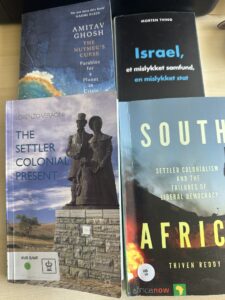
This comment engages four key works: The Settler Colonial Present by Lorenzo Veracini (2015); The Nutmeg’s Curse by Amitav Ghosh(2021); Israel, et mislykket samfund, en mislykket stat -Israel, a Failed Society, a Failed State (2023) by Morten Thing; and South Africa, Settler Colonialism & the Failures of Liberal Democracy by Thiven Reddy (2015). Together, these works trace recurring patterns of settler colonialism across regions including South Africa, Palestine, the Banda Islands, and the Americas.
Veracini conceptualizes settler colonialism as an enduring structure marked by the elimination of Indigenous lifeworlds. He distinguishes settler colonialism from other forms of colonialism through an analogy with biological processes—comparing them to bacteria and viruses—which operate differently, though both are intertwined in exploiting Indigenous bodies, while also seeking their displacement (p. 26). This structure involves environmental transformation, such as large-scale deforestation, and symbolic domination through practices like renaming. As Ghosh argues, renaming functions to erase prior meanings embedded in colonized landscapes. In Palestine, for example, more than ten thousand Arabic place names—villages, valleys, mountains, fields, harbours, cities, and towns—were replaced by Hebrew names, following colonization.
More than 80 forests and parks have also been renamed, often after international donors, contributing to the erasure of Indigenous toponymy. Three examples illustrate this process: the South African Forest established on the lands of Lubya (later contested and partially reversed following protests); Denmark Forest on the site of Allar; and Canada Park on the lands of Imwas – Imwas was one of three villages—along with Yalo and Beit Nuba—that were depopulated and destroyed during the Six-Day War in June 1967.
Acedemian & Literary works also register these dynamics. The War of the Worlds by H. G. Wells reflects exterminatory logics shaped by colonial violence, including the destruction of Indigenous populations in Tasmania. Ghosh further highlights how ecological destruction was integral to these processes: between 1865 and 1883, millions of buffalo were slaughtered in North America, linking the eradication of animal life to the dispossession of Indigenous peoples p. 68. As Nick Estes notes, the destruction of buffalo and Indigenous societies was structurally interconnected.
Similarly, Heart of Darkness by Joseph Conrad exposes the violence of colonial rule in the Congo Free State, encapsulated in Kurtz’s famous expressions: “The horror! The horror!” and “Exterminate all the brutes.” These phrases continue to resonate in contemporary dehumanizing discourses in nowadays Western World.
Morten Thing contributes to this field through a critical analysis of the colonization of Palestine, situating it within the broader history of the “Jewish Question.” His work examines the ongoing displacement of Palestinians since 1948 and can be read alongside two relevant monographs: Three Worlds: Memoirs of an Arab-Jew by Avi Shlaim , where 100.000 Iraqi Jews left Iraq from 1950-1951, p. 105; and The Hundred Years’ War on Palestine by Rashid Khalidi, which offer complementary perspectives. Morten’s book is extremely rich, precise, and well in-depth documented analysis. NB( Morten mentioned the refusal of compensation of 16,324,00 dunums confiscated by Israel, according to UNCCP report; & refusal to apply the 194 UN decision concerning the right of refugees to both Right of Return & Compensation; while accepting to compensate the Christian Germans for the four villages they had confiscated from German Temple company: Sarona, Wilhelma, Betlehem (not the famous Bethlehem) & Waldheim-together with their property in Akka, Haifa, Yafa, Jerusalem. p.105. In 1962, they paid 54 mio. German Marks to both Germany and Australia for the refugees who left the land after 48. p106).
Across cases—from the Americas, Australia, and New Zealand to Indonesia, South Africa, and Palestine—settler colonial projects display shared logics despite differing historical justifications. Whether driven by the spice trade in the early modern period or by oil and gas extraction in the modern era, these projects reveal enduring structures of dispossession and control. Over the past five centuries—since Christopher Columbus reached the Americas in 1492 and Vasco da Gama reached India in 1498—variations of Colonialism have repeatedly reproduced similar patterns, reshaping landscapes and societies in the pursuit of power, control, and profit, often justified through discourses of religion, race, and civilization.
Settler Colonialism Across Contexts: A Comparative Reflection
This comment engages four key works: The Settler Colonial Present by Lorenzo Veracini; The Nutmeg’s Curse by Amitav Ghosh; Israel, et mislykket samfund (2023) by Morten Thing; and South Africa, Settler Colonialism & the Failures of Liberal Democracy by Thiven Reddy. Together, they trace recurring patterns of settler colonialism across regions including South Africa, Palestine, the Banda Islands, and the United States.
Veracini conceptualizes settler colonialism (he differentiates Settler Colonialism from Colonialism by referring to the diference between two biological terms: the bacteria and the virus, that operates differently, although both intertwined to exploit the indigenous bodies mixed with a will to displace them p.26 ), as an enduring structure marked by the elimination of Indigenous lifeworlds. This process includes environmental transformation—such as large-scale deforestation—and symbolic domination through practices like renaming, which, as Ghosh argues, functions to erase prior meanings embedded in colonized landscapes. In Palestine, for example, more than ten thousand names of Arabic origin – villages, valleys, mountains, cities & towns- were replaced by Hebrew names following colonization. More than 80 forests and parks were renamed in Palestine to hold names of international donors & to remove the aboriginal names: Only to name three examples that took place in Palestine in 1948 & 1967: South African Forest on Lubya’s land-recently removed after protests from those South Africans who donate money to plant the forest on the debris of the demolished village….Denmark Forest on the debris of Allar village & Canada Park on the debris of Imwas ( Imwas was one of three villages—along with Yalo and Beit Nuba—that were depopulated and destroyed during the Six-Day War. in june 1967.
Academic & Literary works also register these dynamics. The War of the Worlds by H. G. Wells reflects exterminatory logics shaped by colonial violence, including the destruction of Indigenous populations in Tasmania. Ghosh further highlights how ecological destruction was integral to these processes: between 1865 and 1883, millions of buffalo were slaughtered in North America, linking the eradication of animal life to the dispossession of Indigenous peoples. As Nick Estes notes, the destruction of buffalo and Indigenous societies was structurally interconnected.
Similarly, Heart of Darkness by Joseph Conrad exposes the violence of colonial rule in Congo , encapsulated in the enduring phrase of Kurtz: “horror horror”, “Exterminate all the brutes,” which continues to resonate in contemporary dehumanizing discourses.
Morten Thing contributes to this field through a critical analysis of the colonization of Palestine, situating it within the broader history of the “Jewish Question.” His work examines the ongoing displacement of Palestinians since 1948 and should be read alongside Three Worlds: Memoirs of an Arab-Jew by Avi Shlaim and The Hundred Years’ War on Palestine by Rashid Khalidi, which offer complementary perspectives.
Across cases—from the Americas, Australia and New Zealand to Indonesia, South Africa, and Palestine—settler colonial projects display shared logics despite differing historical justifications. Whether driven by the spice trade in the early modern period or by oil and gas extraction in the modern era, these projects reveal enduring structures of dispossession and control. The last five hundred centuries, since Christopher Columbus reached America in 1492 and Vasco Da Gama reached India in 1498, repeat the same paradigm of Colonialism with all its variations & forms, committing war crimes, rooting up the original people of their colonies, massacring millions through diseases and military attacks, enslaving people to work freely in colonial plantations, destroying the last remnants of the wealthy planet we have for the benefit of the very few who look only for power, dominance, control and profit, covered always with a mantle of religion, race, nation, gender & colour.
وعبر الحالات المختلفة—من الأمريكيتين وأستراليا ونيوزيلندا إلى إندونيسيا وجنوب أفريقيا وفلسطين—تُظهر مشاريع الاستعمار الاستيطاني منطقًا مشتركًا رغم اختلاف المبررات التاريخية. وسواء كانت مدفوعة بتجارة التوابل في بدايات العصر الحديث أو باستخراج النفط والغاز في العصر الحديث، فإن هذه المشاريع تكشف عن هياكل مستمرة من نزع الملكية والسيطرة. وعلى مدى القرون الخمسة الماضية—منذ وصول كريستوفر كولومبوس إلى الأمريكيتين عام 1492 ووصول فاسكو دا غاما إلى الهند عام 1498—أعادت أشكال الاستعمار المختلفة إنتاج أنماط متشابهة، معيدة تشكيل المناظر الطبيعية والمجتمعات في سعيها وراء القوة والسيطرة والربح، وغالبًا ما جرى تبرير ذلك عبر خطابات الدين والعرق والحضارة.